Mindfulness and Art Therapy: A Path to Inner Stability
How many times do we think about the present moment? How many times do we try not to control our thoughts and let ourselves feel things? Do we even care to take a pause and just be present, not with worries but with a space to simply notice?
If we think about this, the answer is NO. Most of us don't. At a given point, we become a sum total of our past thoughts, present tensions, and future worries. That not only creates chaos, but eventually it will make us anxious. How would we tackle this?
Let's say we are practicing archery. To shoot an arrow at the target, we would need enough focus and immense ability to be present. Without mindfulness, our mind will be all over the place, thinking about what if I miss, people are watching me, I need to score well,, and much more. Now one's focus is split between the target and the loop of thoughts. And we know, a shaky mind produces a shaky shot.
Just like in archery, all that matters is we simply being present with enough focus. That is how mindfulness cuts the loop. We stop wrestling with our thoughts and start simply noticing them like clouds passing, not storms to survive. And then we come back. To our breath. To this moment. To this shot.
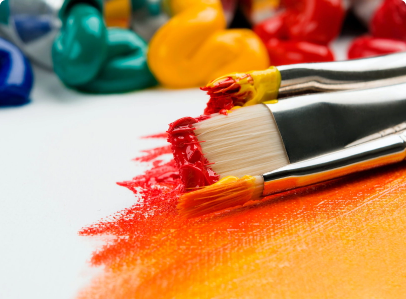
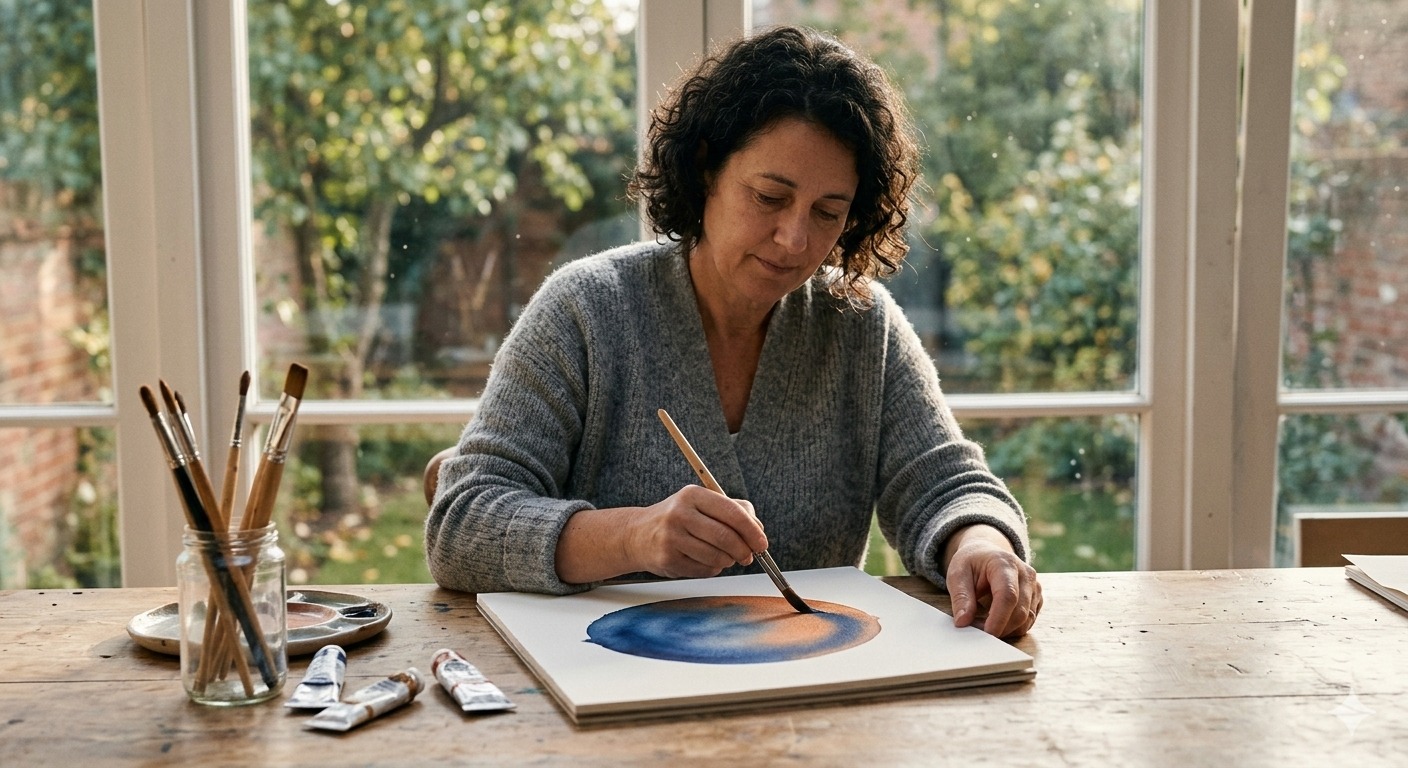
But mindfulness doesn't always arrive through stillness alone. Sometimes it arrives through making something. Now imagine if instead of forcing the mind to become still, we gave it something to hold. Something to move with. Something to create.This is where art therapy becomes powerful. When we hold a brush, we think of one stroke at a time. Just like drawing the bow, it is one breath, one movement, one moment.
With mindfulness we are present rather than thinking about the result. We feel our feet planted on the ground, we notice tension building up in our shoulder and we consciously release it. We are at our best with our focus on the target because now we choose to notice, not to control. We choose to be present, not think about the future. We notice it and release it. In the same way, when we create art mindfully, we are not trying to perfect the whole painting. We are simply staying with one movement at a time. That is the practice. That is the steadiness.
Most of the time, we don't even look at the target clearly. We're aware that something is going on inside us, some anxiety, some restlessness, some joy, but we never really stop to face it directly. We shoot arrows in the dark. Mindfulness is picking up the bow, turning inward, and facing that target fully. Art therapy helps us do exactly that. It gives form to what we are aiming at internally.
In being mindful, we should also be conscious of how we treat our thoughts when they show up. A good archer doesn't grip the bow too tightly. Too much force ruins the shot. So we shouldn't force our thoughts to stay or leave, but rather notice them enough to understand
them or just acknowledge the feeling meaning simply notice. It's about holding a focus firmly but gently, which is exactly the quality a skilled archer develops over time.
The same principle applies when we are creating. Art therapy is not about making beautiful things. It is not about talent or technique. It is about giving our inner world a place to land. When we draw what we are feeling instead of trying to explain it, something different happens. The thought leaves our head and takes a shape outside of us. And the moment it is outside of us, we can actually look at it. We can notice it, the same way a mindful archer notices tension in the shoulder and releases it.
Maybe when it comes to us, the target is our worry. What can we do at that point? We plant our feet. We steady our breath. And now, with calm and undivided attention, we look at exactly what we're feeling, not to judge it, not to fix it, not to run from it, just to see it clearly. The moment we give a full, undistracted attention to what's happening inside us, that's the arrow hitting the target.
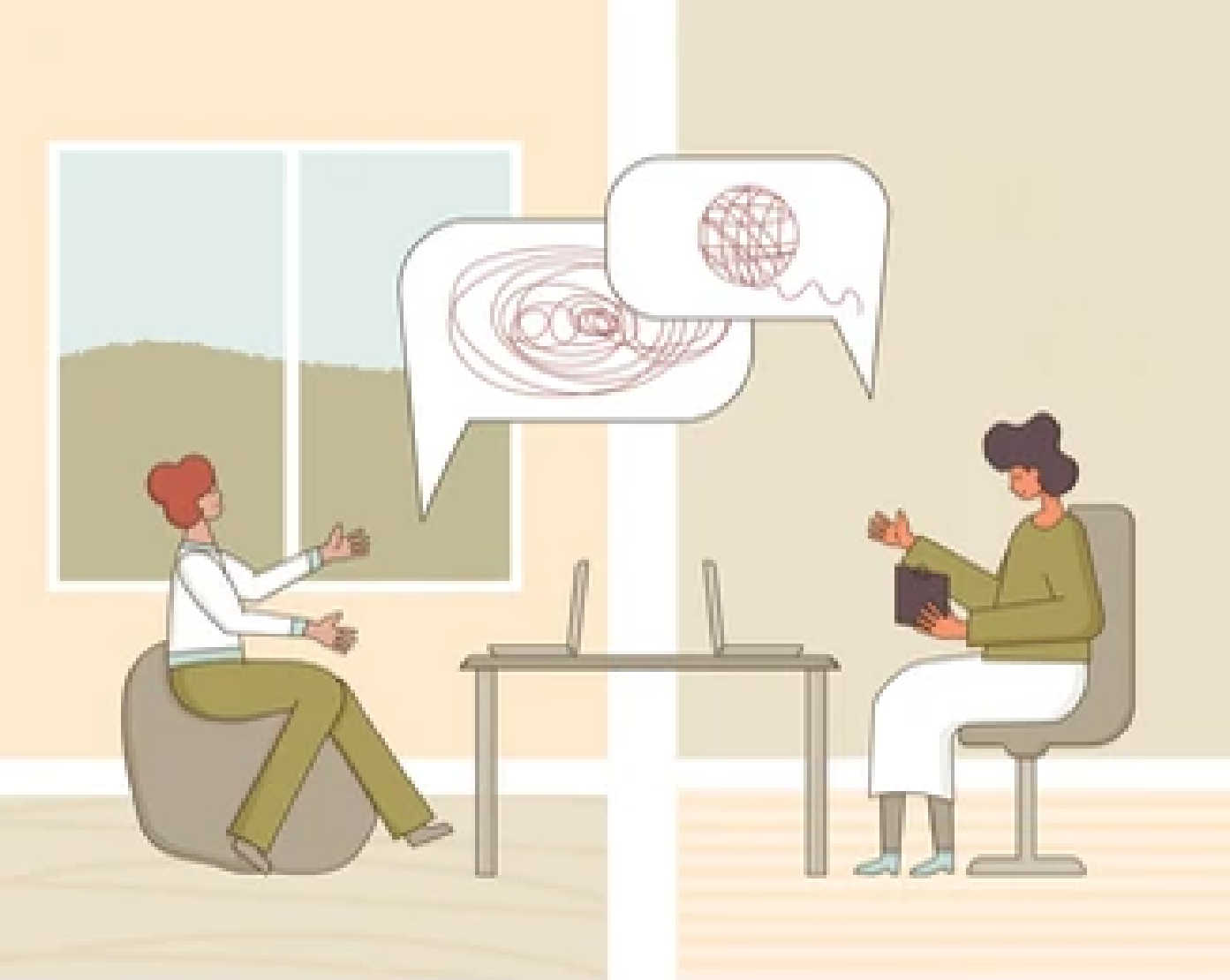
Sometimes the feelings we carry are too tangled for words. We cannot always say what is wrong. But we can reach for a colour. We can press hard on paper when something feels heavy. We can leave a space empty when something feels absent. The art holds it for us without judgment. And that is the practice. Just like mindfulness teaches us to observe without controlling, art therapy teaches us to express without performing. We are not trying to make something good. We are trying to make something honest.
Mindfulness teaches us to observe. Art therapy gives us a medium to do it through. And when both work together, something powerful happens. We are not just calmer at the moment. We become someone who knows how to return to ourselves.
If this way of working with people, with presence, with expression, with healing, speaks to you, then we might have something that can help you dive into this learning. Our Diploma in Art Therapy that would strengthen your knowledge, and would deepen your understanding, both as a practitioner and as a person.
This course is not just about learning techniques. It is about learning to hold space. Learning to sit with someone in their chaos without rushing them toward a resolution. It is about understanding the psychology behind creative expression and how that understanding quietly transforms the way we show up for people.
Because the world needs more people who know how to be present. And who can teach others to be too, and art therapy is just another way of teaching someone to pick up the bow while being conscious and present about the arrow and the follow-through.